William T. Grant Foundation Research Grants: Funding Opportunities, Eligibility, and Application Guide 2026
- August 20, 2026
- No Comments
- Emily Carter
Understanding William T. Grant Foundation Research Grants
William T. Grant Foundation Research Grants are competitive academic research funding awards administered by the William T. Grant Foundation, a private U.S. grant foundation dedicated to advancing social science research on youth development and inequality. These research grants support studies focused on young people ages 5–25 in the United States, and researchers apply through a structured letter of inquiry and full proposal process managed by the Foundation.
This guide covers everything you need to know about William T. Grant Foundation Research Grants:
- What Are William T. Grant Foundation Research Grants?
- Why Research Grants Matter
- Funding Priorities of the William T. Grant Foundation
- Types of Research Grants Offered by William T. Grant Foundation
- Eligibility Criteria for William T. Research Grants
- How to Apply for William T. Grant Foundation Research Grants
- Research Focus Areas in 2026
- Alternative Funding Options for Research Grants
- Common Mistakes in Grant Applications
- Best Way to secure $100,000 Research Grant
- Frequently Asked Questions
The Role of the William T. Grant Foundation in Modern Research
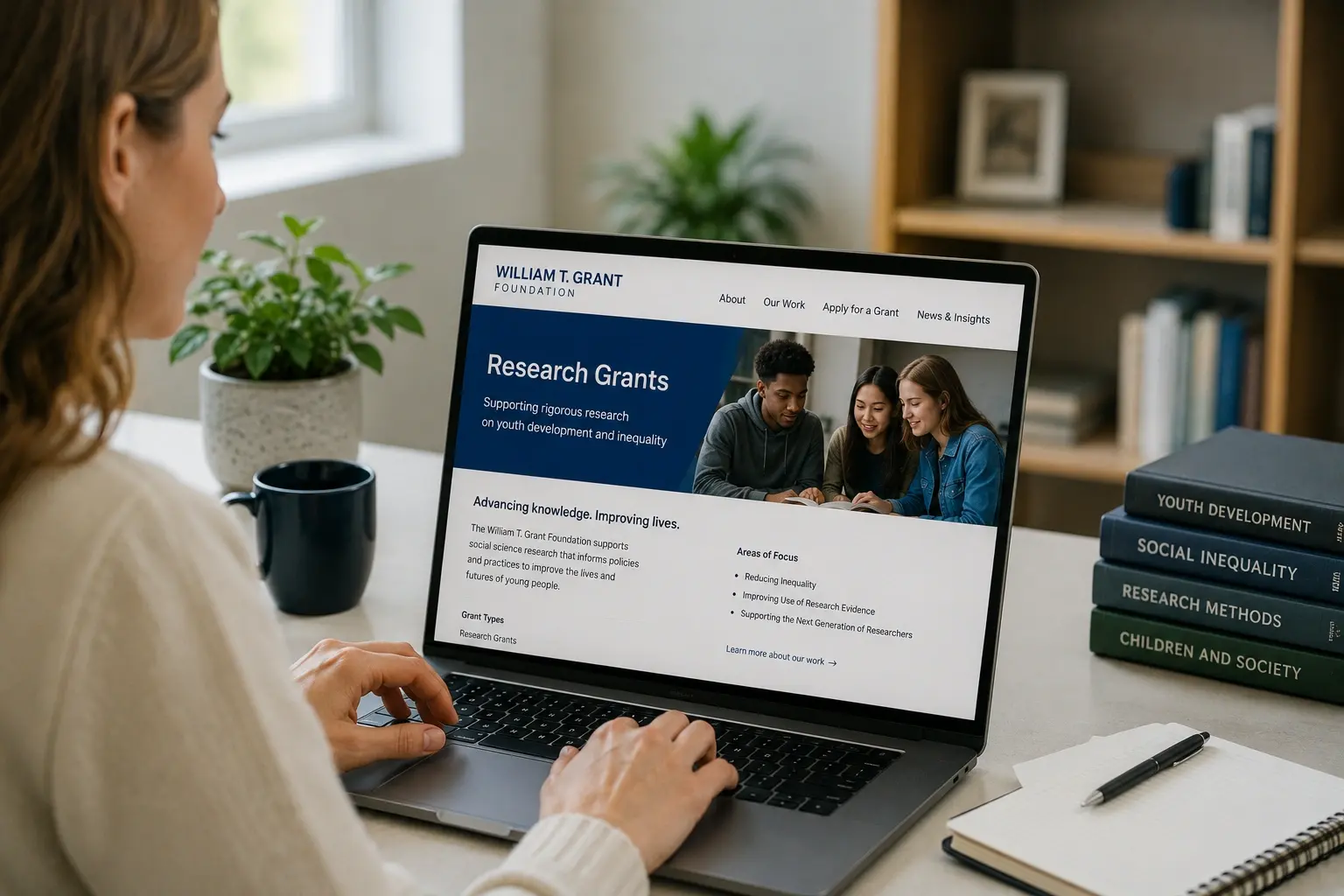
Social science research funding in the United States has never been more critical. As policymakers and practitioners search for evidence-based approaches to address systemic inequality and improve youth outcomes, the demand for rigorous, peer-reviewed research funding outpaces available resources.
The William T. Grant Foundation occupies a distinctive position in this landscape. As one of the most respected foundation research funding programs in the country, it supports interdisciplinary social science research that directly informs decisions that affect young people. Rather than funding service delivery, the Foundation supports research to improve the lives of youth by generating knowledge that public agencies, nonprofit organizations, and policymakers can actually use.
For researchers, principal investigators, and institutions pursuing academic research funding in youth development, inequality, or evidence use, understanding William T. Grant Foundation grants in depth is essential.
What Are William T. Grant Foundation Research Grants?
The William T. Grant Foundation is a private grant foundation established to support research that increases understanding of how to improve the lives of young people in the United States. Its foundation supports research within two focus areas:
- Reducing inequality in youth outcomes
- Improving the use of research evidence in decisions that affect young people
William T. Grant Foundation Research Grants are not general-purpose awards. They fund research studies that aim to build a rigorous, cumulative body of knowledge aligned with the Foundation’s comprehensive research agenda. This focus makes them among the most strategically targeted academic research funding opportunities available to social scientists, child and adolescent development researchers, and policy-focused scholars.
Why William T. Grant Foundation Research Grants Matter
The gap in social science research funding is well-documented. Federal research grants often prioritize biomedical or STEM disciplines, leaving youth development research grants, education inequality research grants, and developmental psychology research funding chronically underfunded relative to need.
The William T. Grant Foundation fills this gap by supporting:
- Youth well-being research grounded in real-world policy contexts
- Evidence-based social policy research that connects findings to practice
- Reducing inequality in youth outcomes through data-driven inquiry
- Social science impact research that shapes legislation, services, and institutional practice
The Foundation’s investments help ensure that research evidence reaches the practitioners and policymakers who shape opportunities for young people, making these research grants among the most consequential in the social science field.
Funding Priorities of the William T. Grant Foundation
Reducing Inequality in Youth Outcomes
The Foundation funds research grants on reducing inequality by examining how policies, programs, and practices to reduce inequality affect outcomes of young people ages 5–25 in the United States. This includes education inequality research grants, economic outcomes of young people, and child and adolescent development studies exploring structural disparities.
Improving the Use of Research Evidence
The Foundation is particularly interested in research on improving the use of research evidence in policy and practice settings. This strand supports research to inform equity-minded decision-making, strategies to improve the use of research in organizations, and applied social research projects examining how nonprofit partners can use research evidence in ways that benefit the populations they serve.
Youth Well-Being Research
Youth well-being research supported by the Foundation investigates social, emotional, and developmental factors shaping outcomes for young people. This includes longitudinal youth studies, program evaluation research, and community-based participatory research that centers youth voice and lived experience.
Evidence-Based Social Policy Research
Evidence-based social policy research funded by the Foundation examines how data-driven policy research can be translated into systemic change. The Foundation supports research to identify effective strategies to ensure that research evidence reaches and influences the decisions of public agencies and policymakers.
Community-Based Participatory Research
Community-based participatory research (CBPR) is a recognized methodology within William T. Grant Foundation grants. CBPR projects that incorporate youth and community perspectives into study design are well-aligned with the Foundation’s commitment to research that increases our understanding of real-world conditions affecting young people.
Types of Research Grants Offered
Major Research Grants
Major research grants support large-scale, rigorous studies aligned with the Foundation’s two focus areas. These are flagship academic research funding awards for institutions and principal investigators with a demonstrated record of conducting high-quality research and an interest in generating findings with policy or practice relevance.
Research-Practice Partnerships
The Foundation supports sustained research-practice partnerships with public agencies or nonprofit organizations in order to reduce inequality or improve research use. These grants enable scholars and practitioners to collaborate on shared questions with real-world stakes.
Institutional Challenge Grant
The institutional challenge grant is a specialized award designed to help academic institutions build internal capacity to support research-practice partnerships. It is available to a limited number of institutions and reflects the Foundation’s long-term investment in organizational infrastructure.
Rapid Response Research Grants
The Foundation developed the rapid response research grants program in 2017 to foster agile uses of research to respond to urgent policy moments. The rapid response research grants program funds research grants to support collaborations between researchers and policymakers when timely evidence is needed. Four new rapid response research grants have been issued in recent cycles, and five new research grants were announced under this program in a prior cohort when the foundation is pleased to announce new directions for research on pressing issues.
Early Career Researcher Grants
Early career researcher grants support emerging scholars at the dissertation or postdoctoral stage. The program funds five-year research and mentoring plans that significantly expand a researcher’s capacity to conduct rigorous social science research. This five-year research and mentoring plans program funds early career development aligned with the Foundation’s focus areas.
Research Fellowship Opportunities
Research fellowship opportunities through the Foundation offer structured funding for scholars building expertise in youth development, inequality, or research use. These research fellowship opportunities are competitive and designed to develop the next generation of leaders in social science research funding.
Eligibility Criteria for William T. Grant Foundation Research Grants
Understanding William T. Grant Foundation Research Grants eligibility is essential before investing time in an application. The core funding eligibility criteria are:
- Academic institutions: U.S. colleges, universities, and research institution affiliates are eligible applicants
- Nonprofit organizations USA: Registered 501(c)(3) organizations conducting research may apply
- Principal investigator grants: A named PI with a strong research record must lead the project
- Early career researcher grants: Scholars within seven years of their terminal degree may apply to the early career program
- Research focus alignment: Projects must fall within the Foundation's two focus areas
- U.S. focus: Research must address young people ages 5–25 in the United States
International institutions are not eligible as lead applicants, though they may participate as collaborators. For a complete breakdown of documentation, compliance rules, and submission guidelines, see our detailed guide on Grant Requirements.
How to Apply for William T. Grant Foundation Research Grants

Understanding how to apply for William T. Grant Foundation Research Grants requires careful attention to the Foundation’s multi-stage process.
Step 1: Monitor grant announcements
Check the Foundation’s website regularly for open grant announcements and requests for proposals within each program.
Step 2: Review grant application guidelines
Each program has distinct grant application guidelines; read them in full before beginning.
Step 3: Submit a Letter of Inquiry (LOI)
Most William T. Grant Foundation grants begin with an LOI stage; strong LOIs are invited to submit full proposals.
Step 4: Develop a full proposal
Successful LOIs receive an invitation and detailed grant proposal guidelines for the full application. Grant Proposal Writing Services can help you structure, refine, and strengthen your proposal.
Step 5: Prepare a research budget
Budgets must align with project scope; foundations scrutinize indirect cost rates and personnel allocations.
Step 6: Compile required attachments
CVs, institutional certifications, and letters of support are typically required.
Step 7: Submit before research funding deadlines
Late submissions are not accepted; track research funding deadlines carefully through the Foundation’s portal. You can also use Grant Submission Support to avoid errors, ensure everything is completed and submitted on time.
Step 8: Await peer-reviewed research funding review
Proposals undergo peer-reviewed research funding evaluation by the Foundation’s expert reviewers
How Professional Grant Writing Services Improve Success Rates
The competitive nature of William T. Grant Foundation Research Grants means that proposal quality is not optional, it is decisive. Professional grant writing services support research teams by:
Identifying aligned funding opportunities across foundation research funding programs, including William T. Grant Foundation funding opportunities and comparable nonprofit foundation grants USA
Developing compelling research narratives that translate rigorous academic work into fundable proposals
Ensuring full compliance with grant application guidelines and institutional requirements
Preparing detailed, defensible budgets that reflect actual project needs
Coordinating submission logistics so that research funding deadlines are never missed
Strengthening evidence-use framing to ensure proposals reflect the Foundation’s interest in research funding support for policy-relevant science
For research teams with strong science but limited grant writing infrastructure, professional grant support can meaningfully improve outcomes in a highly competitive funding environment.
Grant Proposal Guidelines and Best Practices
Strong grant proposal guidelines compliance is a baseline requirement. Beyond compliance, competitive proposals in social science grant writing share several characteristics:
- Precise problem statement: Clearly articulate the gap in youth well-being research or evidence use that the study addresses
- Rigorous methodology: The Foundation expects peer-reviewed research funding standards; mixed methods or longitudinal designs are well-received
- Explicit theory of change: Explain how findings will support research to inform equity-minded decision-making or practices to reduce inequality
- Research-practice partnership framing: Where applicable, describe how nonprofit partners or public agencies will use research evidence generated by the project
- Evidence use integration: Proposals focused on improving the use of research should articulate specific strategies to improve research use in target settings
- Realistic budget: Academic research funding proposals that over- or under-budget raise red flags for reviewers
Research Focus Areas in 2026
For 2026, William T. Grant Foundation Research Grants remain centered on youth outcomes and improving the use of research across institutional settings. Key focus priorities include:
- Reducing inequality in youth outcomes in education, health, and economic domains
- Evidence-based social policy research linking data to legislative and administrative decisions
- Economic outcomes of young people facing structural barriers
- Child and adolescent development studies examining identity, belonging, and transitions
- Use of research evidence by state and local policymakers, including use of research in court and administrative settings, and research evidence by state agencies
- Sustained research-practice partnerships between academic institutions and public agencies or nonprofit organizations
Types of Research Supported
William T. Grant Foundation Research Grants support a wide range of academic research approaches, including:
- Youth development research grants examining social, economic, and institutional influences
- Social science research funding for interdisciplinary and mixed-methods studies
- Education inequality research grants focused on school systems and access
- Developmental psychology research funding for child and adolescent development studies
- Applied social research projects with direct policy relevance
- Program evaluation research assessing the effects of youth-serving programs
- Community-based participatory research centering community knowledge in study design
- Longitudinal youth studies tracking outcomes of young people over time
William T. Grant Foundation vs. Other Research Funding Sources
Funding Source |
Focus Area |
Typical Funding |
Eligibility |
Competition |
Review Process |
|---|---|---|---|---|---|
Youth development, inequality, research use
|
Varies by program
|
Highly competitive
|
Peer-reviewed, multi-stage
| ||
Federal Research Grants (e.g., NIH, NSF)
|
Large awards
|
Wide eligibility
|
Extremely competitive
|
Agency review panels
| |
Private Foundations
|
Varies widely
|
Small to mid-size
|
Often restricted by geography or sector
|
Moderate to high
|
Internal review
|
Academic Funding Programs
|
Discipline-specific
|
Small to mid-size
|
Moderate
|
Departmental or committee
| |
Nonprofit Research Grants USA
|
Program evaluation, community research
|
Modest
|
Nonprofits, community orgs
|
Moderate
|
Mission-alignment review
|
For a broader overview of funding categories, see Types of Grants Available in the US.
Our Experience With Research Grant Applications
Having supported researchers and institutions through multiple cycles of competitive academic research funding, we have observed patterns that rarely appear in official grant application guidelines, but consistently separate funded proposals from those that fall short.
“Good science” is not enough, fit dominates excellence
We have seen methodologically strong proposals rejected simply because reviewers could not place them squarely within the Foundation’s two focus areas. Fit is evaluated before merit. Every sentence in your narrative should speak directly to youth outcomes, inequality, or evidence use.
The trust factor is more important than people think
Reviewers fund teams they believe can execute. A track record of completed projects, published findings, and established partnerships signals reliability. First-time applicants without institutional credibility face a steeper climb regardless of proposal quality.
Networking matters more than most scientists admit
Attending Foundation convenings, engaging with current grantees, and understanding the Foundation’s evolving priorities through direct interaction meaningfully informs proposal framing. Researchers who treat the application as purely transactional miss this entirely.
The budget tells reviewers whether you understand reality
We have reviewed proposals with compelling narratives undermined by budgets that were either implausibly lean or transparently padded. A well-constructed, line-by-line justified budget communicates competence before reviewers read a single aim.
Vague ambition is penalized more than people think
Phrases like “this study will improve youth outcomes” without specifying mechanisms, populations, or measurable change are red flags. The Foundation funds research to identify and test specific pathways, reviewers expect precision.
One weak section can sink the whole proposal
A thin methodology, a missing partnership letter, or an underdeveloped theory of change can override an otherwise strong application. Every section carries weight.
Letters of support are read more carefully than applicants assume
Generic letters are immediately recognizable. A letter of support from a practice partner that articulates a specific research question they need answered, and names how they will use the findings, carries far more credibility than a formulaic endorsement.
Timing your framing to current policy moments matters
The Foundation is particularly responsive to proposals that connect to active policy conversations. Proposals that demonstrate awareness of the current landscape in youth policy, education equity, or research use reform feel timely rather than academic-in-isolation.
Common Mistakes in Grant Applications
Applicants pursuing William T. Grant Foundation grants frequently encounter avoidable setbacks:
- Weak grant proposal structure: Proposals that lack a clear narrative arc fail to communicate significance effectively
- Misalignment with eligibility criteria: Submitting outside the Foundation's focus areas signals poor preparation
- Insufficient evidence use framing: Proposals that don't articulate how findings will reach policymakers miss the Foundation's core interest in the use of research evidence
- Thin methodology: Academic research funding reviewers expect rigorous, clearly articulated research designs
- Budget errors: Inconsistencies between the narrative and budget undermine credibility
- Missing partnership documentation: Proposals claiming research-practice partnerships without letters of commitment are routinely penalized
For a deeper dive into pitfalls and practical solutions, see Common Grant Writing Mistakes and How to Avoid Them.
Tips to Improve Your Chances of Funding Success
- Study funded projects
- Align explicitly with focus areas
- Build interdisciplinary teams
- Engage practice partners early
- Start with the LOI
- Consult grant proposal guidelines repeatedly
Conclusion
William T. Grant Foundation Research Grants represent one of the most rigorous and impactful social science research funding opportunities available to U.S.-based scholars and institutions. By supporting youth development research grants, evidence-based social policy research, and research to improve the lives of young people through better use of evidence, the Foundation advances a comprehensive research agenda with real consequences for equity and opportunity.
Whether you are a principal investigator preparing a major research proposal or an early career scholar building your five-year research and mentoring plans, strategic preparation, partnership development, and precise alignment with the Foundation’s focus areas are essential. The investment in a well-crafted application, supported by strong social science grant writing and rigorous methodology, is an investment in both funding success and long-term scholarly impact.
Frequently Asked Questions
Who can apply for William T. Grant Foundation Research Grants?
U.S.-based academic institutions, research institutions, and registered nonprofit organizations are eligible. A named principal investigator with a relevant research record must lead the project. International institutions cannot serve as lead applicants.
What is the funding focus of William T. Grant Foundation grants?
The Foundation funds research within two focus areas: reducing inequality in youth outcomes and improving the use of research evidence in decisions that affect young people ages 5–25 in the United States.
How competitive are these research grants?
William T. Grant Foundation Research Grants are highly competitive. The Foundation receives far more LOIs than it funds, and the peer-reviewed research funding review process is rigorous. Applicants with strong research records, clear practice partnerships, and proposals tightly aligned with the Foundation’s priorities are best positioned.
What is required in a research proposal?
A complete application typically includes a research narrative, literature review, methodology, theory of change, budget and justification, CVs for key personnel, and documentation of any research-practice partnerships. Full grant application guidelines vary by program and are published with each solicitation.
Are early career researchers eligible for William T. Grant Foundation grants?
Yes. The Foundation offers dedicated early career researcher grants for scholars within approximately seven years of their terminal degree. This program funds five-year research and mentoring plans that significantly expand the researcher’s capacity to conduct high-quality research in the Foundation’s focus areas.
Can nonprofit organizations apply for William T. Grant Foundation Research Grants?
Yes. Registered 501(c)(3) nonprofit organizations in the USA that conduct research, particularly those with established research-practice partnerships with public agencies or academic collaborators, are eligible to apply.
When are research funding deadlines for William T. Grant Foundation grants?
Research funding deadlines vary by program and cycle. Applicants should monitor the Foundation’s official website for current grant announcements and submission windows, as deadlines differ for LOIs and full proposals.
Note: This guide is for informational purposes only. Grant details, eligibility requirements, deadlines, and funding availability may change at any time. Always verify the most current program information through official sources before making any business or funding decisions.
Need Help?
Contact our grant writing experts today to get your right Professional Grant Writer

Author-Emily Carter
Senior Grant Strategist
Emily Carter is a Senior Grant Strategist with more than 20 years of experience helping nonprofits, businesses, educational institutions, and community organizations secure competitive grant funding. She specializes in developing funding strategies, evaluating grant opportunities, and creating winning proposals for government, corporate, and private foundation grant programs.
Her work focuses on aligning organizational goals with funder priorities, developing competitive grant strategies, and ensuring every proposal meets program objectives. By combining strategic planning with deep knowledge of grant funding, she helps organizations pursue high-value funding opportunities with confidence.
Reviewed By-Michelle Bennett
Newsletter
Latest Post
-
 D-Prize Global Pitch Grant: Eligibility, Funding Amount, Challenges, and How to Apply in 202623 Oct 2026
 -
Business Freedom Grant: Eligibility, Application Process, Requirements, and Funding Opportunities in 202621 Oct 2026
-
Multifamily Housing Rental Assistance: Programs, Eligibility, and How to Apply in 202619 Oct 2026