Types of Government Grants: A Complete Guide to Grant Categories, Eligibility, and Funding Opportunities
- October 28, 2026
- No Comments
- GWC
Making Government Grants Work for You
Government grants are non-repayable funding awards made under specific program rules. The main types of government grants can be grouped by how money is allocated (formula, block, categorical, project), how applicants are selected (competitive or noncompetitive), what the money supports, who can receive it, and which level of government funds it. These labels overlap, and eligibility depends on each program.
What Is a Government Grant
A government grant is financial assistance awarded under defined program rules to support an authorized public purpose, such as research, education, community services, infrastructure, or agriculture. Federal agencies, state agencies, and local governments can all award grants.
Grants differ from other government financial assistance:
- Loans must be repaid, usually with interest.
- Contracts pay for goods or services the government itself buys.
- Tax credits and rebates reduce what you owe or refund part of a cost.
- Subsidies lower the cost of something and may not involve an application at all.
- Public benefits are entitlements for individuals who meet set criteria.
- Scholarships, foundation grants, and prizes often come from private sources.
The U.S. government does not hand out universal free money for personal bills or starting a business. Most grants fund defined activities by eligible organizations.
What Are the Main Types of Government Grants
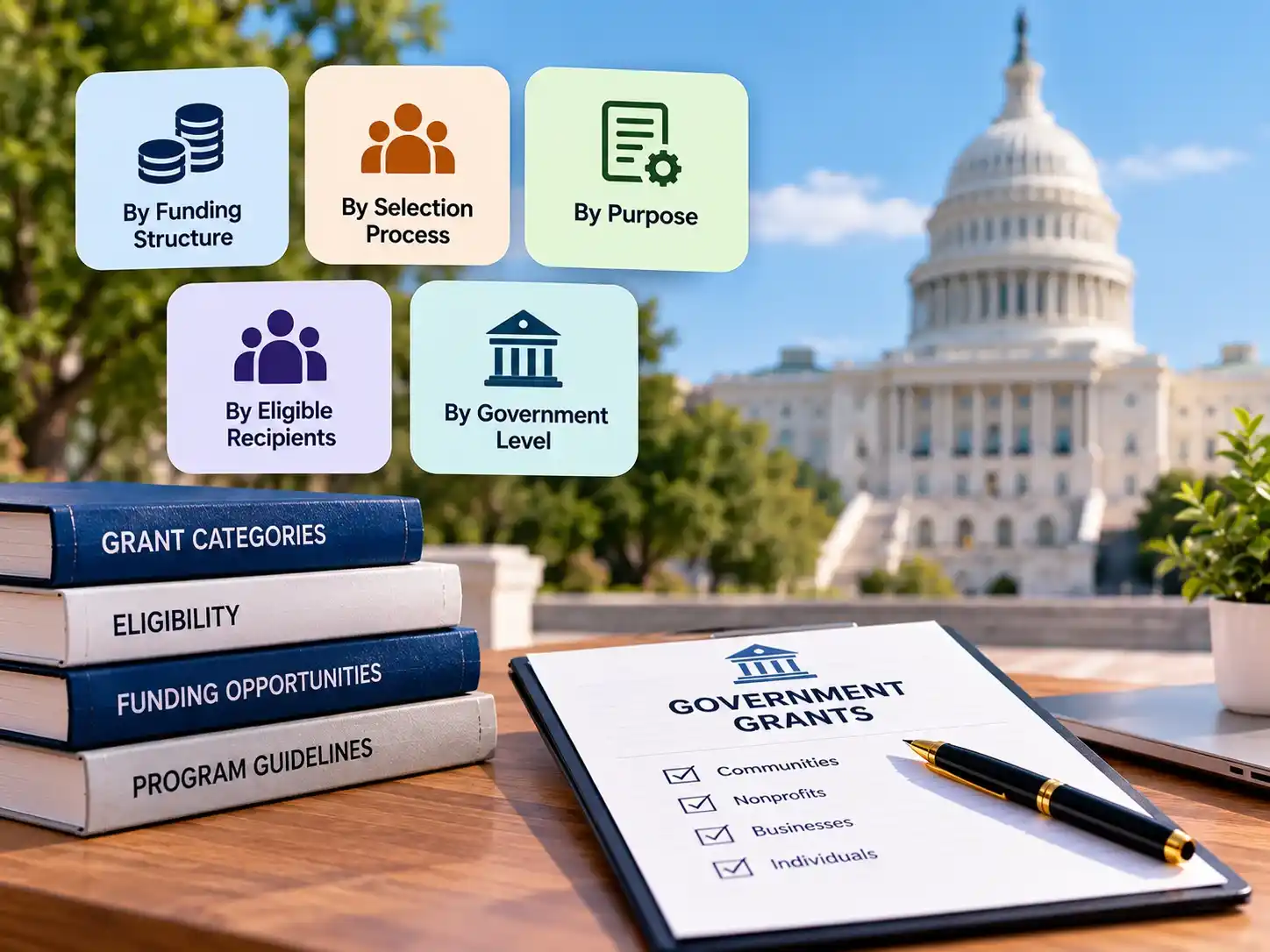
Grants can be classified along five dimensions: allocation method, selection method, intended purpose, eligible recipient, and government level. Because these describe different things, they overlap. A grant can be categorical (restricted purpose), competitive (selected by review), and matching (requiring a contribution) all at once.
Classification |
What it describes |
Key point |
|---|---|---|
Funding restricted to a specific authorized purpose
|
Narrow permitted uses
| |
Block grants
|
Funding for a broader program area
|
More flexibility, still rule-bound
|
Formula grants
|
Funding allocated by a set formula
|
Allocation method, not a guarantee
|
Project grants
|
Funding for a defined project or activity
|
Requires scope, budget, timeline
|
Competitive grants
|
Applications evaluated against published criteria
|
Selection method
|
Funding allocated without a conventional competition
|
Not automatic for everyone
| |
Matching grants
|
Recipient contributes a required share
|
Match rules vary by program
|
Capital grants
|
Eligible capital costs
|
Purpose-based
|
Operating grants
|
Eligible operating costs
|
Purpose-based
|
Pass-through grants
|
Funds moved through an intermediary entity
|
Application may go through a state or local body
|
This is a conceptual summary. Exact meanings depend on the program and its official guidance.
How Do Government Grants Work
The process is generally similar, though not identical for every program:
- A funding agency creates a program and publishes a funding notice.
- Eligible applicants review the guidelines.
- Applicants prepare and submit materials.
- The agency reviews applications or applies its allocation method.
- Awards are approved under program rules.
- Recipients receive funds according to the program’s disbursement procedures.
- Recipients follow spending, recordkeeping, and reporting requirements.
Are Government Grants Free Money
Grants are generally non-repayable, meaning the award itself doesn’t create a debt the way a loan does. But grant money is never unrestricted. Recipients must follow the grant agreement. Unallowable expenses, missed conditions, or violations can lead to corrective action, including repayment.
Who Provides
The agency that funds a program isn’t always the one you apply to. Federal agencies fund and often administer programs directly. State agencies may run state-funded programs or distribute federal money. Counties and cities run local programs within their authority. Always confirm the funding source, the administrator, and where to apply.
Other Types of Grant Funding
- Discretionary grants: Agencies use judgment within statutory, regulatory, and program rules. They aren’t arbitrary.
- Pass-through grants: One government entity receives funds and passes them to another for administration or distribution. The original funder, the pass-through entity, and the final recipient may all differ.
- In-kind grants: Non-cash support such as goods, equipment, or services. Not all in-kind assistance is a formal grant.
- Seed grants: Early-stage or pilot funding. The term doesn’t establish who funds it or who qualifies.
- Development grants: Support for defined economic, community, institutional, or research development goals.
- Infrastructure grants: Often limited to public or eligible entities, not individuals or every business.
- Innovation grants: May require technical merit, research objectives, or commercialization plans. A new idea alone doesn’t qualify.
Grants for Individuals
Some assistance programs serve individuals, such as student aid, housing assistance, and public benefits. Many government grants, though, go to organizations that then serve individuals. A “list of government grants for individuals” may include programs that are loans, benefits, or organization-only. Never assume a listing means you can apply directly.
Federal, State, and Local Government Grants
- Federal government grants are published by federal agencies. Grants.gov is the official starting point for many federal opportunities, but not every program is open to individuals or for-profit businesses.
- State government grants may use state funds or federal money administered by the state. Check your state’s official agency and economic development websites.
- Local government grants come from counties and cities and are often limited by geography.
Funding source, administrator, and application destination can all differ, so confirm each for every opportunity.
Who Can Apply
Eligibility depends on the program. Possible eligible applicants include individuals (where allowed), small businesses, startups, nonprofits, universities, state and local governments, Tribal governments, farmers, and healthcare institutions. Common government grant eligibility factors include:
- Applicant type and legal status
- Location and project purpose
- Industry or research objectives
- Required registrations
- Matching requirements and timeline
These are factors to check, not universal rules.
How to Apply
Step 1: Define Your Funding Needs
Identify your project goals, funding requirements, and how you plan to use the grant money.
Step 2: Find Available Grant Opportunities
Search official federal, state, and local government websites for grants that match your needs.
Step 3: Check Your Eligibility
Review the eligibility criteria to ensure your applicant type, location, and project meet the program requirements.
Step 4: Review the Grant Guidelines
Read the official funding notice carefully, paying attention to eligible expenses, application deadlines, matching requirements, and reporting obligations.
Step 5: Prepare the Required Documents
Gather the necessary application forms, project proposal, budget, organizational details, registration information, and project timeline.
Step 6: Submit Your Application
Complete the application accurately and submit it through the official application portal before the deadline.
Step 7: Understand the Review Process
Check how applications are evaluated. Depending on the program, applications may be scored competitively, screened for eligibility, or assessed using a predetermined allocation formula.
Step 8: Follow the Grant Award Conditions
If approved, use the funds only for authorized purposes, maintain accurate financial records, and meet all reporting and compliance requirements.
Government Grants vs. Loans and Other Funding
Mechanism |
Repayment |
Purpose |
Key difference |
|---|---|---|---|
Generally not, if conditions are met
|
Authorized public purpose
|
Rule-bound and often restricted
| |
Loan
|
Yes, usually with interest
|
Varies
|
Underwriting, repayment terms
|
Tax credit or rebate
|
N/A
|
Reduces tax or refunds cost
|
Separate eligibility rules
|
Contract
|
N/A
|
Government buys goods or services
|
Procurement, not a grant
|
Subsidy or benefit
|
Varies
|
Lowers cost or supports individuals
|
May not involve an application
|
Common Mistakes to Avoid
- Assuming all grants are open to individuals
- Confusing grants with loans or other assistance
- Treating grant categories as mutually exclusive
- Assuming a grant can fund any expense
- Using outdated information or assuming a program is open because a page exists
- Ignoring matching requirements and reporting conditions
- Relying on third-party summaries instead of official guidance
The fix for each is the same: check the official notice.
Grant Selection Checklist
Before pursuing any program, ask:
- Does the notice name my applicant type?
- Is the program currently open, and when is the deadline?
- What can the money pay for?
- Is a match required?
- What reporting will I owe?
- Is this a grant, or a loan or benefit in disguise?
How Grant Writing Company Can Help
Finding the right government grant can be challenging. Grant Writing Company (GWC) helps applicants research funding opportunities, understand eligibility criteria, and prepare clear, well-organized grant proposals.
Whether you represent a nonprofit, run a small business, or have a project to fund, GWC can help you navigate the application process. Contact our team to explore potential funding options for your needs. Grant approval is subject to the funder’s requirements and decisions.
Conclusion
Government grants come in different forms, including categorical, block, formula, project, and matching grants. Each type has specific eligibility criteria, funding purposes, and application requirements. Understanding these differences can help you identify opportunities that align with your goals.
Before applying, review the official guidelines, confirm your eligibility, and prepare the required documents. Grant Writing Company (GWC) can help you research potential funding opportunities and organize your application. With the right preparation, you can approach the grant process with greater confidence, although funding approval is never guaranteed.
Frequently Asked Questions
What is a government grant?
A non-repayable award made under program rules to support an authorized public purpose.
What are the different types?
Categorical, block, formula, project, competitive, noncompetitive, matching, capital, operating, discretionary, pass-through, and others, with overlapping labels.
What is the difference between categorical and block grants?
Categorical grants are narrowly restricted. Block grants allow more flexibility within a broader area.
What are formula grants?
Grants allocated by a program-defined formula.
What are project grants?
Funding for a defined project with a scope, budget, and timeline.
Competitive vs. noncompetitive grants?
Competitive grants are scored against criteria. Noncompetitive grants use other allocation rules and aren’t automatic.
Note: This guide is for informational purposes only. Grant details, eligibility requirements, deadlines, and funding availability may change at any time. Always verify the most current program information through official sources before making any business or funding decisions.
Need Help?
Contact our grant writing experts today to get your right Professional Grant Writer
Newsletter
Latest Post
-
 Types of Government Grants: A Complete Guide to Grant Categories, Eligibility, and Funding Opportunities28 Oct 2026
-
Maryland State Arts Council (MSAC): Grants, Eligibility, and How to Apply in 202626 Oct 2026
-
D-Prize Global Pitch Grant: Eligibility, Funding Amount, Challenges, and How to Apply in 202623 Oct 2026