
How to Identify Red Flags in Grant Guidelines Before Investing Application Time
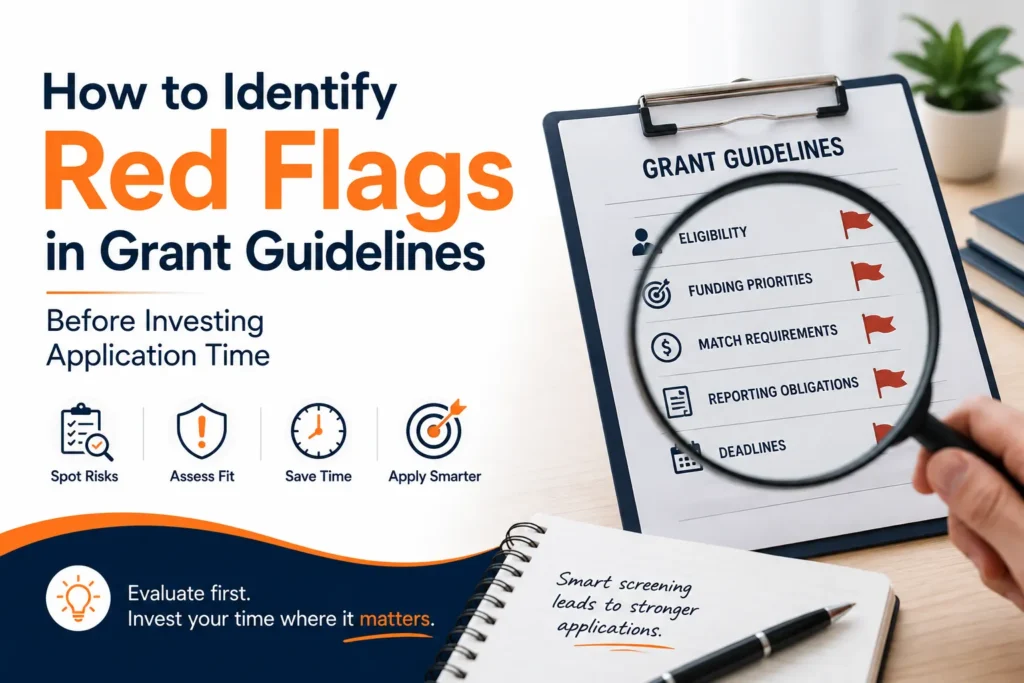
Blog How to Identify Red Flags in Grant Guidelines Before Investing Application Time September 4, 2026 No Comments Michelle Bennett Quick Answer: How to Identify Red Flags in Grant Guidelines To identify red flags in grant guidelines, review eligibility, funding priorities, eligible and ineligible expenses, matching requirements, deadlines, required documents, reporting obligations, and evaluation criteria before you start writing. A grant is worth pursuing only when its requirements, potential funding, and strategic value justify the time it will take to apply. This guide covers everything you need to know about identifying red flags in grant guidelines: Why You Should Screen a Grant Before Applying What Are Grant Red Flags? Common Grant Red Flags Worth Checking How to Evaluate Grant Eligibility How to Determine Grant Fit How to Read Grant Guidelines Efficiently Guidelines vs. Application Requirements Calculating Application Effort and Opportunity Cost Is This Grant Worth Applying For? When Not to Apply for a Grant Go/No-Go Decision Framework Grant Screening Checklist Prioritizing Multiple Grant Opportunities Red Flags That Show Up After You Start Writing How Professional Grant Writers Can HelpHow Professional Grant Writers Can Help Frequently Asked Questions Why You Should Screen a Grant Before Applying A grant application is never just a form. It’s staff time, grant writing time, budget development, letters of support, and often board sign-off, all before you know whether you’ll be funded. When organizations skip this step and apply to every funding opportunity that looks plausible, they spread limited staff capacity across too many low-probability applications instead of focusing effort where it counts. Screening isn’t about avoiding competitive opportunities. It’s about determining application viability before committing application time, so the grants you do pursue have a realistic shot and a manageable cost of applying. What Are Grant Red Flags? Grant red flags are conditions in the guidelines that signal poor grant fit, low likelihood of success, excessive administrative burden, financial risk, or a mismatch between what the funder expects and what your organization can realistically deliver. Not every demanding requirement is a red flag. Detailed reporting, a matching requirement, or a tight budget structure can be entirely reasonable for a well-prepared applicant. A requirement becomes a true red flag when it creates a material mismatch, your organization can’t meet it, can’t afford it, or can’t sustain it without straining operations. Common Red Flags Worth Checking Red Flag Why It Matters What to Check Unclear or narrow eligible applicants Ineligible applicants get disqualified regardless of proposal quality Organizational status, geographic eligibility, years in operation Weak match to funder priorities Proposals that don’t align rarely score well Program priorities, target population, target beneficiaries Narrow eligible activities Time spent on unsupported activities is wasted Eligible vs. ineligible expenses in the guidelines Heavy matching requirements A large mandatory match can change the real value of an award Whether cash or in-kind contribution is realistic Reimbursement funding structure Costs must often be paid upfront, then reimbursed Your organization’s cash-flow requirements and financial capacity Short application window Complex applications need lead time for partners, letters, budgets Submission deadline vs. what the application actually requires Excessive required documents Missing attachments can trigger automatic disqualification Documentation requirements and how quickly they can be gathered Vague scoring criteria Hard to write competitively toward criteria you can’t see Whether evaluation criteria are published or explained Ambiguous guidelines Misreading requirements wastes preparation time FAQs, amendments, or contacting the program officer if permitted Disproportionate reporting requirements Ongoing compliance burden outlasts the application Progress reports, audits, recordkeeping, post-award requirements A requirement in this table isn’t automatically disqualifying, it’s a prompt to verify whether your organization can actually meet it. How to Evaluate Grant Eligibility Eligibility is the first filter, and it’s binary: you either qualify or you don’t. Step 1: Confirm Your Organization Is Eligible Check whether your organization meets the funder’s requirements for eligible applicants, including nonprofit status, sector, organizational type, and size. Step 2: Check Geographic Eligibility Review geographic requirements to confirm that your organization, project, or service area falls within the funder’s eligible locations. Step 3: Review Organizational Requirements Check requirements related to years in operation, annual budget, financial condition, audit history, and other organizational qualifications. Step 4: Confirm Your Project Is Eligible Make sure your proposed project, activities, and intended use of funds fall within the grant’s eligible activities and funding priorities. Step 5: Check Fiscal Sponsorship or Partnership Requirements Determine whether the grant allows fiscal sponsorship or requires a partnership if your organization cannot apply directly. Step 6: Verify the Current Eligibility Criteria Review the official funding notice and current grant guidelines before applying, since eligibility requirements can change between funding cycles. Meeting eligibility gets you in the door. It doesn’t tell you whether you’re competitive, that’s a separate question, addressed next. If you need help identifying grants that align with your organization’s eligibility, goals, and funding needs, grant research services can help you find relevant funding opportunities and save time during the research process. How to Determine Grant Fit Fit measures how well your project aligns with what the funder actually wants to fund, beyond the baseline eligibility check. Factor Ask Yourself Risk Level if Weak Mission alignment Does this funder support work like ours, consistently? High Project fit Does our project match their stated priorities without stretching? High Funding fit Does the award amount match our actual budget need? Medium Capacity fit Can we staff and deliver what’s proposed? High Timeline fit Does the funding period match our implementation timeline? Medium Reporting burden Can we sustain the compliance requirements post-award? Medium If you find yourself reshaping your mission to match a funder’s language, that’s usually a sign of weak strategic alignment rather than genuine fit. How to Read Grant Guidelines Efficiently A practical sequence for reading grant guidelines without missing hidden requirements: Eligibility and applicant eligibility Funding priorities and funding criteria Award amount and funding amount Allowable vs. unallowable costs Deadlines (LOI, submission, reporting) Application requirements and required attachments Evaluation and scoring criteria Reporting and compliance requirements Matching or cost-sharing requirements
Grant Prospecting: How to Identify the Best Funding Opportunities

Blog Grant Prospecting: How to Identify the Best Funding Opportunities August 22, 2026 No Comments Jason Brooks Grant Prospecting: A Strategic Approach to Finding the Right Grants Grant prospecting is the process of researching, qualifying, and prioritizing potential funders whose mission, funding priorities, and eligibility requirements align with your organization’s goals and needs. Instead of applying to every available grant, organizations identify grant opportunities most likely to result in a strong, sustainable funder relationship. This guide covers everything you need to know about the Grant Prospecting: What Is Grant Prospecting? Why Grant Prospecting Matters for Nonprofits What Makes a Grant Opportunity a Good Fit? Where to Find Grant Opportunities How to Research Potential Funders How to Use IRS Form 990s for Grant Prospect Research How to Qualify and Prioritize Grant Prospects Grant Prospect Qualification Quick-Check Grant Prospect Research Template How to Build a Grant Pipeline Grant Prospect Qualification Checklist Common Grant Prospecting Mistakes How Grant Writing Company Can Help With Prospecting Frequently Asked Questions Grant Prospect Qualification Quick-Check Table Detail What to Check Funder Name the foundation, government agency, corporation, or other grantmaker. Funding opportunity Identify the specific grant program or funding opportunity. Mission alignment Confirm that the funder’s mission aligns with your nonprofit’s mission. Program fit Check whether the funder supports your program area, project scope, or target population. Eligibility Verify applicant eligibility and all stated eligibility requirements. Geographic focus Confirm that your service area or project location is eligible. Funding priorities Review the funder’s current priorities, focus areas, and program interests. Funding history Examine past grants, previous grantees, and award history when available. Grant size Compare the typical or stated grant award amount with your funding needs. Funding cycle Determine whether the opportunity is currently open and how often the funder accepts applications. Deadline Record the current application deadline and verify it with the official source. Application requirements Review the application process, required documents, LOI, proposal, budget, and other requirements. Reporting requirements Determine what reporting, evaluation, or outcome requirements may apply. Relationship Note any existing connection with the funder, board members, partners, or previous contacts. Organizational capacity Assess whether your team can complete the application and fulfill the grant requirements. Fit score Assign a consistent score based on mission, eligibility, geography, funding, timing, and capacity. Priority Classify the prospect as High, Medium, or Low priority. Next action Record the next step, such as research, cultivation, inquiry, application, or monitoring. Verification source Record the official funder website or other authoritative source used to verify the information. Last verified Record the date the opportunity was last reviewed so outdated information can be identified. Why Strategic Grant Prospecting Matters Grant prospecting is more than typing a phrase into a grant database and clicking through results. It’s a deliberate process of identifying grant opportunities that genuinely fit your organization, then qualifying and prioritizing those prospects before you invest time in a grant application. Nonprofits that skip this step often end up applying broadly, hoping something sticks. That approach burns staff hours on funding opportunities with weak mission alignment or eligibility gaps that were visible from the start. A strategic approach to funder research helps you focus limited time on prospects with real potential, and it turns a scattered grant search into a repeatable grant prospecting strategy that feeds a consistent grant pipeline. What Is Grant Prospecting? Grant prospecting sits at the front of the grant lifecycle. It’s distinct from grant writing, which happens later, and from grant research, which is the broader activity of gathering information about funding sources. A simplified version of the process looks like this: Research → Identify → Qualify → Evaluate → Prioritize → Cultivate → Apply → Track Prospect research focuses on one funder at a time and includes examining their funding priorities, giving history, and eligibility requirements. Grant prospecting is the overall discipline that turns that research into a working grant prospect list and, eventually, a grant pipeline of qualified opportunities. Why Grant Prospecting Matters for Nonprofits Every grant application takes staff time, whether the funder ultimately says yes or no. Strategic prospecting protects that time by concentrating effort on funders with genuine strategic fit. It also supports: Funding diversification: Reducing reliance on any single funder or grant type Long-term funding strategy: Building relationships instead of one-off asks Reduced wasted effort: Fewer applications, better targeted A large grant isn’t automatically a good grant. If the funder’s geographic focus, target population, or program area doesn’t match your work, size alone won’t make it worth pursuing. What Makes a Grant Opportunity a Good Fit? Before investing time in an application, evaluate these factors: Factor What to Check Mission alignment Does the funder’s stated purpose match your work? Funder priorities Have they funded similar programs recently? Geographic eligibility Do they fund in your service area? Grant size Does their typical award match your funding needs? Eligibility requirements Do you meet 501(c)(3), budget, or other criteria? Deadline and funding cycle Is there enough time to prepare a strong application? Reporting and matching requirements Can your organization realistically meet them? Where to Find Grant Opportunities Foundation grants come from private foundations, community foundations, and other charitable foundations. Many maintain published funding priorities and application requirements on their websites. Government grants are offered by federal, state, and local agencies. Federal opportunities are centralized on Grants.gov; state and local grants are usually posted on the relevant agency’s site. Corporate grants stem from corporate philanthropy programs, often tied to a company’s business interests or community footprint. Each source has strengths and limits, foundation grants tend to be more flexible, government grants often carry heavier reporting requirements, and corporate grants may be more restricted in scope. Grant Databases and Prospect Research Tools Grant databases can make grant prospecting much faster by bringing opportunities, funder information, deadlines, eligibility, and funding details into one place. I’ve personally used Grant Anchor, and what I liked most was how it personalized the prospecting process. After filling in my organization details, funding needs, and other profile information, its AI
Grant Resubmission: How to Revise and Resubmit a Grant Proposal

Blog Grant Resubmission: How to Revise and Resubmit a Grant Proposal August 20, 2026 No Comments Michelle Bennett Turning Grant Reviewer Feedback Into a Stronger Resubmission Grant resubmission means revising and submitting an unfunded proposal for another round of review, usually in response to reviewer feedback. A rejected or unfunded grant application is not necessarily the end of the funding opportunity, but a resubmission should not simply repeat the original application. Reviewer feedback matters because it identifies the specific concerns that kept the proposal from being competitive. Resubmission rules vary by funder, so check the current funding guidelines before assuming a rejected proposal is eligible to be resubmitted. Resubmission can improve an applicant’s chances, but it does not guarantee funding. This guide covers everything you need to know about the grant resubmission: What Is Grant Resubmission? Can You Resubmit a Rejected Grant Proposal? Should You Resubmit the Same Proposal and When? What to Do After a Grant Is Rejected How to Read Reviewer Feedback How to Respond to Reviewer Comments How to Strengthen a Grant Application Grant Resubmission Letter Grant Resubmission Checklist Common Grant Resubmission Mistakes When NOT to Resubmit NIH-Specific Guidance NSF Grant Resubmission Grant Resubmission vs. Applying to Another Funder Need Help With a Grant Resubmission? Frequently Asked Questions About Grant Resubmission What Is Grant Resubmission? Grant resubmission is submitting a revised version of a previously reviewed, unsuccessful grant application. A grant proposal resubmission typically responds directly to reviewer comments and strengthens the sections that scored weakly. This differs from a grant revision, the editing process itself, a broader term some funders use for any subsequent attempt. Not every funder uses these terms identically, so check each opportunity’s own language. Term Typical Situation Grant resubmission Funder has an official, formally designated resubmission category Grant reapplication Applying again, used loosely across funders regardless of formal status Grant revision Editing the proposal itself, at any stage New application No resubmission option, or the project idea changed Application to another funder Original funder isn’t a fit or doesn’t accept resubmissions Practical tip: Don’t rely on the term “resubmission.” Check the funder’s current rules for eligibility, format, timing, and whether the next application is treated as a resubmission or a new application. Can You Resubmit a Rejected Grant Proposal? It depends on the funder. Some programs have a formal resubmission process; others treat every submission as new. Before assuming eligibility, check the funding opportunity’s: application requirements resubmission guidelines current application cycle any required waiting period Don’t assume every rejected proposal can simply be resubmitted unchanged. Should You Resubmit the Same Proposal and When? Resubmitting doesn’t mean sending the same document again. A competitive resubmission usually addresses reviewer feedback point by point, fixes identified proposal weaknesses, strengthens evidence or methodology, and updates the grant budget where needed. Some proposals need only targeted revisions; others need a redesigned methodology or narrower project scope. Consider resubmitting when the opportunity is still open and fits the project, eligibility still holds, reviewer feedback points to fixable issues, the project remains feasible, and there’s enough time for meaningful revisions before the deadline. Rushing a weak revision into the next deadline is often worse than waiting for a cycle that allows time to fix major issues. Before You Rewrite: Decide Whether the Proposal Is Actually Recoverable A grant rejection does not automatically mean the proposal needs another round of editing. Before investing substantial time in a resubmission, separate three questions that applicants often treat as one: Is the organization eligible? Is the project eligible? Is the application realistically competitive? Eligibility is only the starting point. A proposal can meet every stated requirement and still be a poor investment of application time if the project does not closely fit the funder’s current priorities, the reviewers identified a fundamental problem, or the requested funding cannot realistically support the proposed work. A useful pre-revision test is: Fit: Does the current funding opportunity still prioritize the problem, population, geography, activities, or outcomes the project addresses? Feedback: Are the most important reviewer concerns specific enough to fix? Feasibility: Can the methodology, timeline, staffing, evaluation plan, or budget actually be strengthened before the next deadline? Evidence: Can the revised application provide better support for claims that reviewers questioned? Competitive position: After the revisions, will the proposal present a substantially stronger case, or will it remain weak on a factor that is central to the funder’s decision? Opportunity cost: Is revising this proposal a better use of limited staff time than pursuing another funding opportunity? The most important question is therefore not simply, “Can we resubmit?” It is “Can we make the application meaningfully better?” If the answer is yes, build the revision around the highest-impact weaknesses rather than editing every paragraph equally. If the answer is no, a different funding opportunity, a redesigned project, or a later application cycle may be more strategic. This distinction also helps prevent a common resubmission problem: treating reviewer comments as a proofreading list. A comment about weak evaluation, unclear methodology, or questionable feasibility may require a change to the underlying project design, not just better wording. What to Do After a Grant Is Rejected Read the funding decision and reviewer comments in full Review the grant score and identify strengths and weaknesses Separate major problems from minor issues Build a revision plan, prioritized by importance Address reviewer feedback and strengthen real gaps Recheck the funding opportunity for changed guidelines Get an independent review, then submit the revised application How to Read Reviewer Feedback Look for recurring concerns across reviewers first, a shared concern carries more weight than one reviewer’s opinion. Group comments into critical issues (could prevent funding), major issues (substantive gaps in methodology, significance, or feasibility), minor issues (clarity, formatting, missing detail), positive feedback (strengths worth preserving), and conflicting feedback (points where reviewers disagree). Prioritize concerns that affect the proposal’s core logic, such as need, activities, outcomes, evaluation, and budget. If multiple reviewers flag related issues, treat them as one major revision priority. How to Respond to
Grant Proposal vs Business Proposal: Key Differences, Similarities, and When to Use Each

Blog Grant Proposal vs Business Proposal: Key Differences, Similarities, and When to Use Each July 4, 2026 No Comments Michelle Bennett Understanding How Grant Proposals and Business Proposals Differ A grant proposal requests funding from a grantmaker, government agency, or foundation with no repayment required. A business proposal offers products or services to a client or partner in exchange for payment. The core difference: grant proposals seek financial support for a mission-driven purpose; business proposals generate revenue through a commercial agreement. This guide covers everything you need to know about the grant proposal and the business proposal: What Is a Grant Proposal? What Is a Business Proposal? Grant Proposal vs Business Proposal Similarities Between Grant Proposals and Business Proposals Key Components of a Grant Proposal Key Components of a Business Proposal Grant Proposal Format vs Business Proposal Format When to Use a Grant Proposal When to Use a Business Proposal Grant Proposal vs Investment Proposal vs Project Proposal Can One Proposal Be Converted Into the Other? Common Mistakes to Avoid How Professional Grant Writers and Proposal Experts Can Help Frequently Asked Questions Why This Distinction Matters Many organizations sit down to write a funding document and immediately face the same question: is this a grant proposal or a business proposal? The confusion is understandable. Both documents make a case for support. Both require research, clear writing, and a compelling argument. But submitting the wrong type, or writing one with the structure of the other, can quietly destroy your chances before a reviewer reads past the first page. Whether you’re a nonprofit chasing foundation funding, a startup trying to win a first client, or an entrepreneur exploring government grants, understanding grant proposal vs business proposal is one of the most practical decisions you can make before writing a single word. What Is a Grant Proposal? A grant proposal is a formal document submitted to a funding organization, such as a government agency, private foundation, or corporate sponsor, requesting financial support for a specific project or program. The funding is typically non-repayable, meaning the recipient is not expected to return grant money as long as they meet the grant program requirements. Grant proposals are used by nonprofit organizations, research institutions, schools, community development groups, and increasingly by businesses qualifying for federal funding or small business grants. Common audiences for a grant proposal: Federal and state government agencies Private foundations Community foundations Corporate giving programs International funding bodies Example: A nonprofit organization seeking $150,000 from a private foundation to expand a youth literacy program would submit a grant proposal outlining the statement of need, program outcomes, project budget, and evaluation plan. What is a grant proposal at its core? It is a promise: here is a problem, here is how we will solve it, and here is exactly how the money will be used. What Is a Business Proposal? A business proposal is a document that offers a product, service, or solution to a prospective client, partner, or investor. Unlike a grant application, a business proposal leads to a commercial transaction, the proposing party generates revenue if accepted. What is a business proposal in practice? It is a persuasive sales document that demonstrates value, outlines scope of work, presents pricing strategy, and moves a client toward a signed contract. Common audiences for a business proposal: Prospective clients Corporate procurement teams Business partners Investors evaluating a revenue model Organizations issuing a Request for Proposal (RFP) Example: A marketing agency submitting a service proposal to a retail company, offering a six-month digital marketing engagement with defined deliverables, contract terms, and return on investment projections. Business proposals drive client acquisition, business growth, and strategic partnerships. They are the engine of commercial revenue generation. Grant Proposal vs Business Proposal: Quick Comparison Table Factor Grant Proposal Business Proposal Purpose Secure non-repayable funding Win a client or commercial contract Audience Grantmaker, foundation, government agency Client, investor, partner, procurement team Funding Source Grants, public funding, donations Client payment, investment, partnership revenue Revenue Expectation None (mission-driven) Direct revenue generation Structure Narrative-heavy, compliance-driven Solution-focused, commercially persuasive Budget Format Program budget with budget justification Pricing strategy and project budget Evaluation Process Grant reviewer scores against criteria Client evaluates value and feasibility Success Metric Program outcomes and social impact ROI, deliverables, client satisfaction Approval Process Proposal approval by funding committee Signed agreement or contract Reporting Grant reporting to funding agency Performance reporting per contract terms Compliance Grant compliance with funder guidelines Regulatory and contractual compliance Difference Between Grant Proposal and Business Proposal Understanding the difference between grant proposal and business proposal goes beyond document formatting. The two documents exist in fundamentally different ecosystems. Purpose A grant proposal exists to serve a mission. A business proposal exists to close a deal. Funders want to see community impact; clients want to see competitive advantage and ROI. Target Audience Grant proposals are reviewed by grant reviewers who score submissions against a rubric tied to the agency’s mission. Business proposals are evaluated by decision-makers who care about price, feasibility, and value proposition. Funding Goals Grant funding supports projects that typically cannot sustain themselves through revenue alone, community programs, research initiatives, public benefit projects. Business proposal writing targets revenue-generating engagements where payment follows performance. Revenue Expectations A grant funder explicitly does not expect a financial return. An investor or client absolutely does. Mixing these expectations is one of the most damaging mistakes a proposal writer can make. Proposal Evaluation Grant proposals are scored on needs assessment quality, program outcomes, organizational capacity, and budget justification. Business proposals are evaluated on scope of work clarity, pricing transparency, proof of results, and competitive differentiation. Compliance Requirements Grant compliance is often extensive, federal grants especially require adherence to specific reporting formats, funding eligibility rules, and use-of-funds restrictions. Business proposals operate under contractual and commercial law. Reporting and Accountability After receiving a grant, organizations submit grant reporting documents demonstrating how the money was used. Business contracts measure success through deliverables and key performance metrics. Long-Term Impact Successful grant proposals often include a sustainability
Letter of Support for Grants: Complete Guide, Examples, Templates, and Best Practices in 2026

Blog Letter of Support for Grants: Complete Guide, Examples, Templates, and Best Practices in 2026 July 6, 2026 No Comments Sarah T What Is a Letter of Support (Quick Answer) A letter of support for grants is a formal document from a third-party organization or individual endorsing a grant application. Funders request it to verify that real partnerships exist, resources are available, and the project is feasible. It should be written by someone with authority to commit the described resources, such as an executive director, department chair, or agency director, and it strengthens a proposal by demonstrating credibility, community buy-in, and stakeholder investment. This guide covers everything you need to know about grant support letters in 2026: What Is a Letter of Support? Who Should Write a Grant Letter of Support? How to Write a Grant Support Letter: Step-by-Step Letter of Support Template Template 1: Problem–Solution–Impact (Basic Grant Narrative) Template 2: Personal Connection & Community Stakeholder Template 3: Evidence-Based / Data-Driven Support Template 4: Institutional Partnership (University–NGO–Government Collaboration) Template 5: Endorsement From an Authority Figure (Expert Validation) Grant Letter of Support Example Scenario 1: Government Agency Letter of Support Scenario 2: University Research Collaboration Letter Scenario 3: Nonprofit Partnership Support Letter Scenario 4: Corporate CSR Funding Support Letter Scenario 5: Healthcare Grant Support Letter (Hospital/Clinic Endorsement) Letter of Support vs. Letter of Commitment Essential Elements of an Effective Letter of Support Best way to Increase Your Chances of Grant Approval Frequently Asked Questions Understanding Letter of Support for Grants When a review panel evaluates hundreds of competing applications, one question shapes every score: is this project actually going to work? Strong methodology and compelling data matter, but what tips the balance is evidence that the people and organizations needed to execute the project have already signed on. That evidence comes in the form of a letter of support. For nonprofits, research institutions, healthcare organizations, educational programs, and community-based organizations alike, a well-written grant support letter transforms a promising proposal into a fundable one. It signals to reviewers that partnerships are genuine, not aspirational. Funders, whether a federal agency (like NIH or USAID), a private foundation, or a state government program, rely on support letters precisely because they are external validation. Anyone can claim community support in a narrative. A signed letter on official letterhead, from someone who can actually deliver what it promises, is an entirely different kind of evidence. Who Should Write a Grant Letter of Support? The single most important rule: the signatory must have the authority to commit the resources described in the letter. For nonprofits and community organizations: The Executive Director or CEO. A program manager may handle internal coordination, but only an executive has the authority to allocate the organization’s personnel, resources, facilities, or budget commitments. For universities and research institutions: A Department Chair, Dean, or the Office of Sponsored Research, depending on what is being committed. If the letter involves lab access or equipment time, the relevant principal investigator or facility director is appropriate. For hospitals and healthcare systems: The Chief Medical Officer, Chief Medical Information Officer, or Hospital Administrator, depending on whether the commitment involves clinical access, data, or IT infrastructure. For government agencies: The Permanent Secretary, Agency Director, or Division Chief. A letter from a mid-level analyst promising policy alignment carries far less weight than one signed by someone who actually controls those decisions. For companies and industry partners: The Plant Manager, Division Head, or VP of the relevant business unit, whoever can authorize the donated equipment, software licenses, or staff hours being committed. For individual expert endorsements: Recognized senior practitioners, former collaborators, or advisory board members who have genuine credibility in the field. How to Write a Grant Support Letter: Step-by-Step Step 1: Understand the grant requirements Read the RFP to identify what types of support letters are required, how many are needed, any formatting specifications, and whether a commitment letter (rather than a support letter) is required. Step 2: Review the proposed project Ask the applicant for a 1–2 page project summary, the specific aims or objectives, and the section of the proposal most relevant to your contribution. Step 3: Explain the relationship Open the letter by establishing organizational credibility and any history with the applicant team. Step 4: Demonstrate support Articulate why this project matters to your organization specifically, not grant funding in general. Step 5: Describe contributions precisely Use numbers: staff hours, patient counts, dollar values, dataset sizes, number of workshops. Quantified commitments are what separate excellent letters from marginal ones. Step 6: Confirm commitment and add appropriate caveats A typical disclaimer like “This letter is intended as a good-faith indication of support and remains subject to the organization’s usual approval processes” helps safeguard both sides while preserving trust and credibility. Step 7: Finalize format and submit Use official letterhead, obtain an authorized signature, convert to PDF, and deliver on time. If you’re also working on the bigger picture of grant writing, it may help to look at our guide on How to Apply for Grants, which walks through the full application process from preparing your proposal to submitting it effectively. Letter of Support Template The following five templates cover the most common scenarios grant writers encounter. Each is structured differently to match its specific purpose, choose the one that fits your partner type and adapt accordingly. Template 1: Problem–Solution–Impact (Basic Grant Narrative) Best for: General nonprofit, community program, and foundation grants where reviewers prioritize narrative logic. [OFFICIAL LETTERHEAD] [Date] [Funder Name] [Grant Program Name and Reference Number] [Address] RE: Letter of Support for “[Project Title]” – [PI Name], [Lead Institution] Dear [Program Officer or Selection Committee], [Organization Name] is pleased to express our strong support for the proposed project submitted by [Lead Institution]. [Two sentences on who you are and your mission.] This project directly aligns with our strategic priorities because [specific organizational reason, not generic]. [Describe any prior collaboration with the applicant team.] Should this project be funded, [Organization Name] commits to providing: [Specific contribution
When Is FAFSA Due for 2026–27? Full FAFSA Deadline Guide

Blog When Is FAFSA Due for 2026–27? Full FAFSA Deadline Guide July 6, 2026 No Comments Sarah T When Is FAFSA Due for 2026–27? Missing a single deadline can cost students thousands of dollars in financial aid. If you’re wondering when is FAFSA due for 2026-27, you’re asking the right question at the right time. The FAFSA deadline 2026-27 is not a single date, it’s a layered system of federal, state, and institutional deadlines, each with real consequences for the financial aid you receive. This complete guide answers every question about the 2026-27 FAFSA deadline, helps you understand what aid is at stake, and walks you through exactly how to apply step by step. What Is FAFSA? The Free Application for Federal Student Aid (FAFSA®) is the official application for federal student aid, administered by the U.S. Department of Education. It is the single most important document in the college funding process. Every year, the FAFSA determines eligibility for billions of dollars in grants, loans, and work opportunities. Completing the FAFSA unlocks access to: Aid Type Description Federal Pell Grant Need-based grant, no repayment required Federal Direct Subsidized Loans Government covers interest while enrolled Federal Direct Unsubsidized Loans Available regardless of income level Federal Work-Study Part-time on-campus or community employment FSEOG Grants Additional grants for students with exceptional need State & Institutional Aid Schools and states use FAFSA information to award their own funds The formula colleges use is simple: Cost of Attendance (COA) – Student Aid Index (SAI) = Financial Need A lower SAI generally indicates a higher eligibility for need-based financial aid. There is no income cutoff to apply, every student should file. Want to know if you could qualify for FREE Pell Grant money? Read my detailed guide on “Pell Grant Eligibility Income” and discover the income limits most families misunderstand. When Does FAFSA Open for 2026–27? A common question is: when does FAFSA open for 2026-27? The FAFSA application 2026-27 became available on September 24, 2025, six days ahead of the statutory October 1 deadline, making it the earliest release date in program history. The Department of Education conducted an extensive beta testing program beginning August 4, 2025, to ensure system stability before the public launch. By the time the form became available to all students, it had been stress-tested across millions of simulated submissions. Why does the opening date matter? Because many states and colleges have priority deadlines as early as January or February. The earlier you access the FAFSA application 2026-27, the better your position for limited state grant funds. FAFSA Deadline 2026–27 Explained Understanding the full picture of the 2026-27 FAFSA deadline requires knowing three separate deadline tiers. Federal FAFSA Deadline For the 2026–27 academic year, the FAFSA must be submitted by June 30, 2027, according to the federal deadline. The FAFSA corrections deadline (the last date to make corrections or updates) is September 10, 2027. While this federal student aid deadline may seem distant, waiting until June means you’ve already missed most state and school-level aid. State FAFSA Deadlines State FAFSA deadlines are often months earlier than the federal cutoff. These earlier deadlines exist because state grants are funded pools, once the money runs out, it’s gone. State Priority Deadline Program California March 2, 2026 Cal Grant (California Student Aid Commission) Connecticut February 15, 2026 State Need-Based Aid Tennessee April 1, 2026 TN Promise Program Alabama May 1, 2026 State Grants, SEOG, Work-Study Georgia June 30, 2027 HOPE/Zell Miller Scholarship Post-award reporting Often unstructured Reporting templates and tracking Funding strategy Reactive Planned funding pipelines Students are encouraged to pay close attention to their state FAFSA deadlines, and consider state deadlines as their real FAFSA due date. Many states operate their aid programs on a first-come, first-served basis, filing on March 2 for California’s Cal Grant or by April 1 for Tennessee’s promise grant is non-negotiable. College Priority Deadlines For a deeper breakdown of timelines, deliverables, and workflows, see what happens after you hire a grant writing company. What Happens when the FAFSA is not submitted on time? Missing the FAFSA due date 2026-27 has real costs. Here’s what’s at stake by deadline tier: Miss the state deadline: You become ineligible for most state grant programs for that award year, including the Cal Grant, Tennessee Promise, and similar financial aid programs, often worth thousands of dollars. Miss the institutional priority deadline: Colleges may have already exhausted their discretionary grant funds. Your financial aid offer could shift heavily toward loans. Lose Work-Study access: Federal Work-Study is limited and allocated early. Missing the FAFSA priority deadline means those positions likely go to students who filed first. Reduced Pell Grant opportunity: While pell grant eligibility is not strictly first-come, first-served, a late filing delays your aid award and can disrupt enrollment timelines. Miss the federal deadline (June 30, 2027): You are no longer considered for federal student aid for the entire 2026-27 award year. No exceptions. Best Time to Submit FAFSA for 2026–27 The best time to submit the FAFSA is as soon as the form opens, ideally in October or November. The earlier you submit, the better your chances of accessing the full range of need-based aid available at both the state and institutional level. Here is the ideal FAFSA submission timeline: Period Action September-October 2025 Create FSA ID, submit FAFSA immediately November-December 2025 Review FAFSA Submission Summary; correct any errors January-March 2026 Meet state and institutional priority deadlines March-June 2026 Review financial aid award letters from schools June 30, 2027 Absolute federal deadline for 2026-27 FAFSA The earlier you fill out your FAFSA, the more control you have over your student financial aid 2026-27 outcomes. Delaying until spring often means applying for the limited funds that are still available. FAFSA Eligibility Requirements for 2026–27 Before you apply for financial aid, confirm you meet the FAFSA eligibility requirements: Citizenship: Must be a U.S. citizen, U.S. national, or eligible noncitizen (permanent residents, refugees, and certain visa holders qualify) Social Security: Must have a valid social